
Congress vs. Trump: Tariff Power STRUGGLE Begins
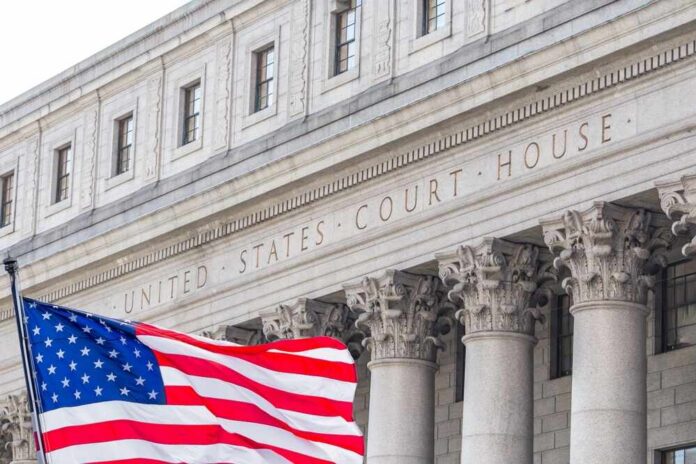
The Supreme Court just blocked President Trump’s sweeping “emergency” tariffs—and within hours he found a new legal lever to keep the pressure on global trade.
Quick Take
- The Supreme Court struck down Trump’s broad global tariffs that were imposed under the International Emergency Economic Powers Act (IEEPA).
- Trump responded on Feb. 20, 2026 with a new 10% global tariff order using Section 122 of the Trade Act of 1974, which carries a 150-day limit.
- The ruling reinforced that tariff power originates with Congress, limiting attempts to use emergency statutes to reshape trade policy.
- Trump signaled additional options—including older, rarely used tariff authorities—suggesting the legal and political fight is far from over.
Supreme Court Blocks IEEPA Tariffs, Forcing a Fast Pivot
President Donald Trump held a press conference on Feb. 20, 2026 after the U.S. Supreme Court rejected his attempt to impose sweeping global tariffs under the 1977 IEEPA. The Court’s decision followed earlier litigation in the U.S. Court of International Trade, which found that IEEPA could not be used to address trade deficits in the way the administration attempted. Trump publicly criticized the justices and framed the ruling as wrong but manageable.
The immediate takeaway is structural: the Court drew a boundary around executive power that many Americans—especially those wary of unelected bureaucracies and “rule-by-emergency” government—have wanted enforced for years. Tariffs may be popular or unpopular depending on the industry, but the constitutional question is hard to ignore: the power to tax and set tariffs starts with Congress. The Court’s ruling signaled that statutes written for emergencies cannot be stretched indefinitely to run trade policy by decree.
Section 122: A 10% Global Tariff With a Clock Running
Trump responded the same day by announcing and signing a new 10% global tariff under Section 122 of the Trade Act of 1974. Reports described Section 122 as a faster tool than other trade authorities because it does not require the same kind of investigation process, but it is also temporary—generally capped at 150 days unless Congress acts to extend or replace it. That shift changes the battlefield from courts alone to Congress, too.
The Section 122 move also changes the politics around accountability. A short-term tariff that must be extended pushes lawmakers to go on record, instead of letting the White House absorb all responsibility. That matters for voters who watched the prior era’s spending sprees, inflation shocks, and “we know better” governance. Trade policy affects prices and jobs, but it also tests whether elected representatives will do their job or hide behind executive workarounds when choices get hard.
Why the Court’s Ruling Matters Beyond Trade
The underlying dispute wasn’t simply about imports; it was about how far an administration can go by declaring an “emergency” and then using that label to justify sweeping economic controls. Trump’s IEEPA theory was novel because IEEPA has traditionally been associated with sanctions and targeted restrictions, not a blanket tariff regime aimed at chronic trade imbalances. The Supreme Court’s rejection reflected skepticism toward turning a sanctions statute into a broad tariff engine.
For conservatives, that separation is important even when the policy goal is sympathetic. Many Trump voters support using leverage to get better trade terms and bring manufacturing back, but they also want constitutional guardrails to hold—especially after years when left-leaning institutions championed aggressive administrative power in everything from energy rules to education mandates. When courts clarify that Congress must be involved, that is a reminder that “ends” do not erase “means,” even in a fight over globalization.
What Comes Next: More Authorities, More Negotiations, More Risk
Trump indicated his team is considering other legal mechanisms to impose tariffs, including rarely used authorities that could allow higher rates in certain circumstances. Reporting also noted discussion of tools such as import licensing and older provisions that have sat dormant for decades. Those ideas may face political resistance, legal scrutiny, or practical limits, but they show the administration is not backing away from a tariff-centered strategy heading toward the midterms.
Canada’s response underscored how complicated the next phase could become. Coverage indicated that prior tariffs—such as earlier steel and aluminum measures—remain part of the landscape, while trade under USMCA frameworks can buffer some impacts. Industry voices in Canada described the Court’s move as a “rule of law” win, and analysts pointed out that Section 122’s time limit increases pressure on Congress. With the 10% tariff now active, businesses and consumers face near-term cost questions, while Washington braces for the next legal and legislative round.
Sources:
https://www.politico.com/news/2026/02/20/donald-trump-tariff-supreme-court-reaction-00791245
https://www.whitehouse.gov/videos/president-trump-on-the-supreme-courts-tariff-decision/