
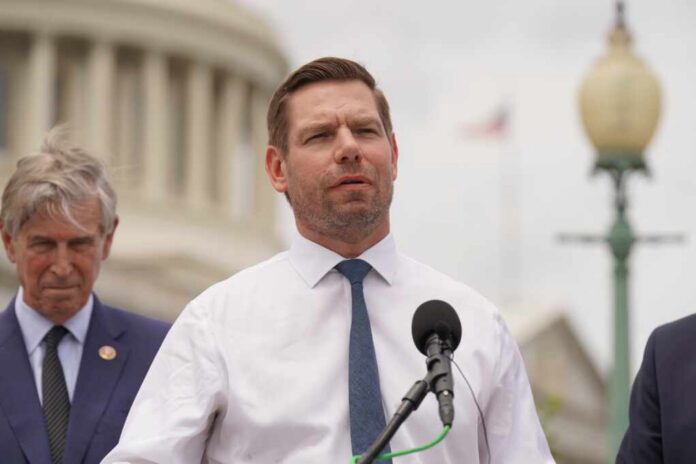
A leading Democrat’s California governor campaign is unraveling in real time after sexual assault allegations triggered a rapid, public revolt from his own party’s power brokers.
Quick Take
- A former staffer accused Rep. Eric Swalwell of two sexual assaults, one in 2019 and another in 2024, according to reporting that cited text messages and people she confided in.
- Within hours, prominent Democrats and key allies publicly urged Swalwell to leave the race, sharply narrowing his path to the June 2 primary.
- Swalwell denied the allegations, called them politically timed, and signaled legal action; the accuser has not filed a police report and remains unnamed.
- The episode highlights how elite-driven party discipline can move faster than formal investigations, leaving voters to sort through claims, denials, and political incentives.
Allegations and Denials Put a Front-Runner Under a Spotlight
Reporting published Friday, April 10, described accusations by a former staffer that Rep. Eric Swalwell sexually assaulted her twice—once in 2019 when she was 21 and working for him, and again in 2024 after a charity gala. The account said she was intoxicated in both incidents and unable to consent, and it described her telling others afterward. Swalwell flatly denied wrongdoing and framed the claims as politically motivated.
The case remains politically explosive because the reporting arrived as California’s gubernatorial primary clock runs down. The accuser did not go to police, saying she feared not being believed, and no criminal charges have been filed. That uncertainty matters: Americans across the spectrum have watched high-profile allegations become instant verdicts online, even as genuine victims often struggle to be heard through formal systems that can feel slow, hostile, and impersonal.
Democratic Leaders Pull Support at Speed—Before Any Official Finding
Democratic condemnation came quickly and publicly. Speaker Emerita Nancy Pelosi, via a spokesperson, said the allegations must be respected and heard and suggested the matter be addressed outside the campaign. Rep. Robert Garcia called the allegations “indefensible” and urged Swalwell to exit immediately. Other figures and organizations reportedly moved to distance themselves as well, signaling to donors and activists that the campaign had become a liability, not an asset.
The speed of the backlash is the story inside the story. Political parties often preach standards but apply them unevenly, depending on who holds power and what the electoral stakes are. Here, party leaders acted as if the political cost of delay was higher than the cost of pre-judging. That may satisfy some voters who want swift accountability, but it also reinforces a growing cynicism that career survival and narrative management—rather than due process—drive decision-making in elite circles.
Rumors, “Receipts,” and the Hard Problem of Verification
Weeks before the April 10 report, social media rumors circulated about Swalwell and staff behavior, but those claims were described as vague and unverified. The newer reporting raised the evidentiary temperature by citing text messages and witnesses the accuser spoke to at the time. Still, key facts remain unresolved in public view: the accuser’s identity has not been independently confirmed in all coverage, and there has been no court process to test competing claims under oath.
Swalwell’s team rejected the allegations as “outrageous” and suggested political opponents were behind them, while also indicating a legal response. The accuser, represented by counsel, reportedly received a cease-and-desist letter. For voters, this kind of standoff is familiar: a serious accusation, a categorical denial, and a media-and-social-media feedback loop that can reward the loudest voices. The responsible approach is to separate what is alleged from what is proven—without dismissing alleged victims or granting politicians automatic immunity.
What the Collapse Signals for Voters Who Feel the System Is Rigged
This controversy lands in a broader climate where many Americans—conservative and liberal—believe government and political institutions protect insiders first. Conservatives often see a double standard in how media and party leaders handle misconduct depending on ideology. Many liberals see power shielding powerful men until it becomes politically inconvenient. Either way, the episode underscores how quickly elite networks can coordinate to cut off a candidate when they believe the brand is threatened, regardless of whether the public has seen a full accounting.
California’s governor race now faces a practical question: will voters accept an elite-driven “forced exit,” or will some recoil at what feels like a verdict delivered by press release? With ballots approaching, the immediate consequences may be less about courtroom outcomes and more about coalition math—endorsements, unions, and party institutions steering turnout. For Americans already frustrated by corruption, bureaucracy, and self-preservation in politics, the deeper takeaway is that trust remains the scarce commodity.
Pelosi, California Dems slam Swalwell over bombshell sexual assault allegations: 'Indefensible' https://t.co/MIt383POHt #FoxNews
— Ritchie Vassalini (@RitchieBusetta) April 11, 2026
The bottom line is that the public still lacks complete visibility into the underlying evidence, while political actors are behaving as though the conclusion is foregone. That tension—between a demand for accountability and a demand for fair process—will keep driving anger on both sides. As this story develops, the most important facts to watch are whether additional reporting brings new corroboration, whether any formal complaint is filed, and whether Swalwell stays in the race without meaningful institutional support.
Sources:
Eric Swalwell’s governor bid is collapsing as top Democrats turn on him
Democratic allies yank support for Swalwell’s California governor run after assault allegations
Eric Swalwell California governor candidate denies misconduct allegations