

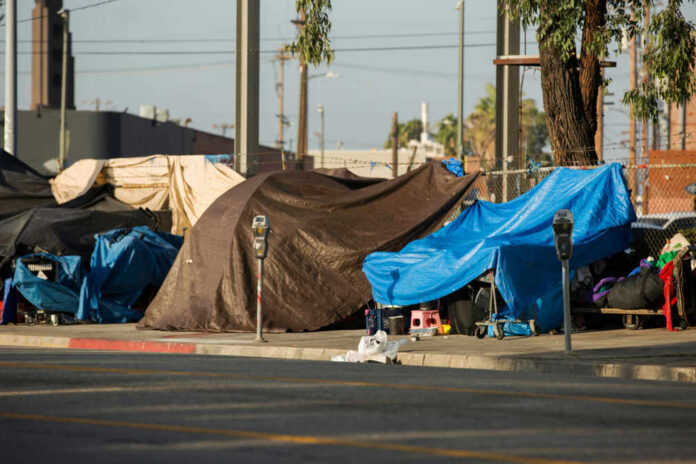
A disturbing pattern of violent attacks against homeless Americans has escalated into a deadly epidemic, with young perpetrators targeting vulnerable victims in encampments while policies criminalize homelessness instead of addressing the root causes.
Story Snapshot
- At least 1,657 homeless individuals suffered violent attacks over 17 years, with 428 murdered, often by young male “thrill offenders” seeking peer validation
- California cities saw enforcement citations skyrocket up to 500% following the Supreme Court’s 2024 Grants Pass ruling allowing blanket camping bans
- Violence against homeless Americans occurs at rates far exceeding FBI-tracked hate crimes, with 48% of recent attacks proving fatal
- Experts warn that policies criminalizing homelessness send a message that unhoused lives don’t matter, emboldening attackers who view victims as less than human
Deadly Trend Targets America’s Most Vulnerable
The National Coalition for the Homeless documented a shocking reality between 2005 and 2022: 1,657 homeless Americans faced violence solely because of their housing status. These weren’t robbery attempts or random crimes—perpetrators specifically targeted victims for being unhoused. California experienced 43 of 199 documented attacks during just 2014-2015, with incidents frequently occurring in RV camps and street encampments where victims slept outdoors. Los Angeles alone recorded 85 homeless murders in 2021, a record high that underscores how dangerous American streets have become for those without shelter.
Young Attackers Following Dangerous Patterns
Research identifies a disturbing perpetrator profile: young males acting as “thrill offenders” who attack homeless individuals for excitement and peer validation. Professor Brian Levin from California State University San Bernardino notes these attacks mirror hate crime patterns, with offenders exploiting stereotypes and dehumanizing narratives. Recent incidents illustrate this brutality—San Diego saw three deaths and one critical injury from outdoor attacks, while New York experienced multiple stabbings and shootings of sleeping homeless victims. The violence isn’t spontaneous; it’s fueled by societal messages that unhoused Americans deserve their fate.
Young man 'enraged by the homeless' before being charged with execution at squalid RV camp https://t.co/45jJlyqAg1 pic.twitter.com/B5DAZ0yJzl
— New York Post (@nypost) March 13, 2026
Supreme Court Ruling Intensifies Crisis
The June 2024 Grants Pass v. Johnson decision allowed cities to enforce blanket camping bans without providing shelter alternatives, triggering massive enforcement increases. San Francisco citations jumped 500% from 71 to 427, Los Angeles arrests surged 68%, and San Diego doubled from 524 to 1,045 citations. Sacramento saw citations triple to 283 immediately post-ruling, reaching 844 by May 2025. Over 50 California cities and counties passed new encampment ordinances, prioritizing criminalization over housing solutions. This approach displaces vulnerable individuals into even riskier situations without addressing underlying homelessness.
Failed Policies Perpetuate Violence
University of Colorado Anschutz research reveals encampment sweeps produce only minor, temporary crime reductions of 10-15 incidents per quarter-mile, with no lasting public safety benefits. Meanwhile, UCSF homelessness research demonstrates that providing housing cuts violence risk in half—a solution ignored by enforcement-first policies. Anti-camping laws in 187 cities correlate with violence rates that double FBI-tracked hate crimes across all protected classes. The homeless face astronomical violence rates, with 48% of homeless women experiencing physical violence in six-month periods. Cities strain resources on citations and arrests while housing assistance remains critically underfunded, perpetuating cycles of vulnerability.
Constitutional Concerns and Common Sense Solutions
Criminalizing homelessness raises serious questions about equal protection and cruel-and-unusual punishment, particularly when shelter alternatives don’t exist. The current approach punishes poverty rather than solving it, contradicting American principles of human dignity and individual liberty. Data shows housing-first approaches halve assault risks and provide lasting solutions, yet political momentum shifts toward criminalization. Conservative values traditionally emphasize personal responsibility, but also recognize government’s proper role in removing barriers to self-sufficiency. Mental health service gaps and housing shortages aren’t solved by citations—they require addressing root causes. The dehumanization of homeless Americans through failed policies enables violence, creating dangerous streets for everyone while wasting taxpayer resources on enforcement instead of solutions that work.
Young man ‘enraged by the homeless’ before being charged with execution at squalid RV camp The 23-year-old man fueled with anger over the homelessness crisis in Los Angeles has been charged with murder, prosecutors say. https://t.co/ay55qYub65 pic.twitter.com/TKngAxf6Ky
— NahBabyNah (@NahBabyNahNah) March 13, 2026
Sources:
Violence Against People Experiencing Homelessness: A Hidden Epidemic – UCSF Homelessness Research
After Supreme Court Ruling, Homeless Enforcement Data Shows California Crackdown – CalMatters
Report Shows Rising Violence Against Homeless People – Invisible People
The Disturbing Realities of Homelessness and Violence – National Alliance to End Homelessness