

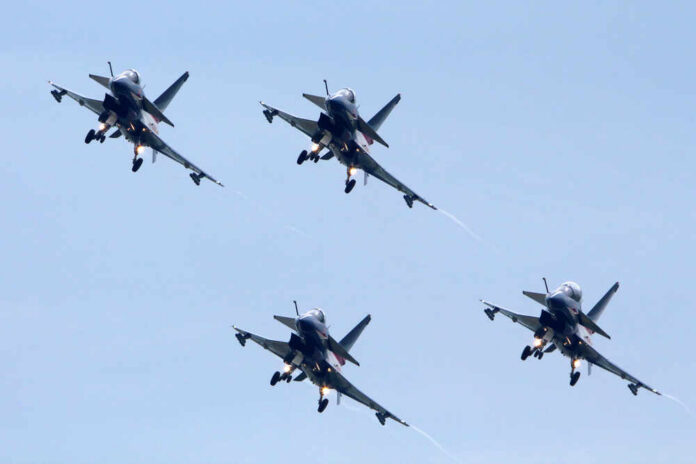
1,000 J-20s? U.S. Airpower PANICS
China’s push toward a rumored 1,000-jet J-20 stealth fleet by 2030 is the kind of “numbers game” that can quietly erase U.S. air dominance if Washington treats it like another media headline.
Story Snapshot
- Recent reporting projects China could scale its J-20 “Mighty Dragon” force toward 1,000 aircraft by 2030, a level that would overwhelm U.S. advantages through sheer volume.
- Open-source tracking places the J-20 program well past “prototype” status, with the fighter in PLAAF service since 2017 and upgrades accelerating through 2023–2026.
- China is pursuing new variants, including a twin-seat J-20S and a maritime strike-focused variant, signaling broader missions beyond air-to-air.
- Key uncertainty remains the pace and maturity of engine upgrades, but multiple sources agree production tempo is faster than comparable Western stealth-fighter pipelines.
The “1,000 by 2030” Projection—and Why Quantity Matters
February 2026 estimates circulating in defense commentary argue China could reach a 1,000-aircraft J-20 inventory by 2030, framing the result as a “flying horror show” for any opponent forced to fight outnumbered for years. Even if the exact number proves optimistic, the strategic point is straightforward: mass matters. In a Taiwan Strait or South China Sea scenario, sortie generation and replaceable airframes can be as decisive as top-end performance.
U.S. conservatives remember how Washington’s priorities drifted for years—endless spending with little readiness to show for it, political “equity” checklists in institutions, and a globalist mindset that treated industrial capacity like an afterthought. A large J-20 fleet highlights the downside of that complacency. Airpower is not just technology; it is production, maintenance, munitions stockpiles, and pilot training at scale, all of which are harder to surge once a crisis starts.
What the J-20 Is Designed to Do in a Real Fight
The J-20 entered service in 2017 after a first flight in 2011, marking China’s operational move into fifth-generation stealth aviation. Open-source technical descriptions emphasize low-observable shaping, diverterless supersonic inlets, and internal weapon bays optimized for beyond-visual-range engagements. Reported performance figures commonly cited include Mach 2 capability, high ceiling, and long reach, with Chinese doctrine pairing fighters with sensors and early-warning aircraft to extend detection and targeting across contested airspace.
Weapons carriage is central to the threat calculation. The J-20 is widely associated with long-range air-to-air missiles such as the PL-15, and its overall concept points toward pushing U.S. forces farther from the fight—especially tankers, ISR aircraft, and carrier air wings that rely on predictable operating areas. For the U.S. and allies, that raises the importance of resilient basing, dispersed operations, and a deep magazine of air-to-air and air-defense interceptors.
Upgrades, New Variants, and the Push for Manned-Unmanned Teaming
Reporting since 2023 has highlighted upgrades that go beyond incremental tweaks: radar improvements, avionics changes, electronic resilience, and continuing engine development are recurring themes. Chinese military commentary has also stressed integration with unmanned systems—pairing stealth fighters with drones and support aircraft to widen sensor coverage and complicate adversary targeting. That matters because a stealth jet is most dangerous when it is part of a network that can find, track, and shoot first.
China’s aircraft industry has signaled broader roles for the platform family. A twin-seat J-20S variant has been publicly discussed as a way to expand mission sets such as electronic warfare, command-and-control, and directing unmanned teammates. Separately, U.S. naval reporting in January 2026 described China unveiling a J-20 variant presented as capable of striking maritime targets. Taken together, those developments point to a platform China wants to use across air superiority, sea denial, and complex “sensor-shooter” chains.
What’s Confirmed, What’s Unclear, and What U.S. Policy Must Prioritize
Open sources broadly agree on the direction of travel—more airframes, more variants, and continued modernization—but some specifics remain uncertain. Engine transition details are frequently debated, and not every claim about fleet-wide configuration is independently verifiable. The 1,000-jet figure is a projection rather than a confirmed inventory. Still, conservative-minded voters should focus on the reality beneath the hype: China is building capacity while the U.S. must avoid peacetime assumptions.
1,000 Mighty Dragons: The Chilling Math of China’s J-20 Fighter 2030 Stealth Fleethttps://t.co/qXsVcsIygo
— 19FortyFive (@19_forty_five) February 20, 2026
President Trump’s second-term environment puts the emphasis back where it belongs: defending national sovereignty, rebuilding industrial strength, and prioritizing deterrence over lectures from international bureaucrats. The J-20 story is a warning that the Indo-Pacific balance can shift through production lines as much as through diplomacy. If America wants peace through strength, it must maintain readiness, accelerate next-generation capabilities, and ensure allies can hold the line without waiting for permission from distant committees.
Sources:
China set to ‘supercharge’ fifth-gen J-20 stealth fighter with radar, engine and AI upgrades
China Reveals New J-20 Fifth-Gen Fighter Variant, Can Strike Maritime Targets
China’s Secret H-20 Stealth Bomber Can Be Summed Up in 2 Words
How Good is China’s J-20 “Mighty Dragon”?