
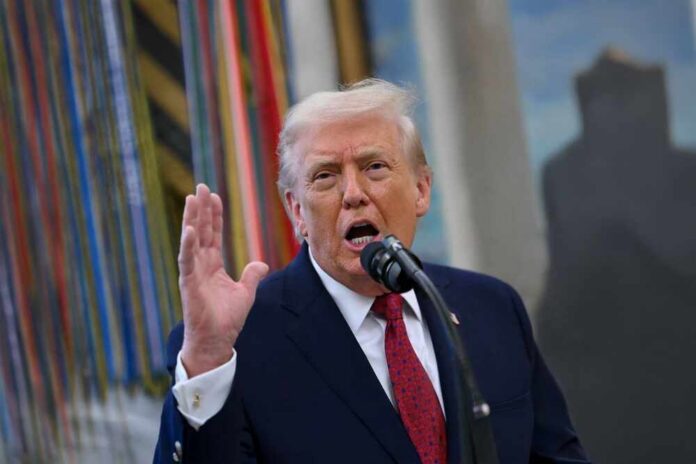
President Trump admitted he doesn’t know whether his Justice Department’s $1.8 billion “anti-weaponization” fund is dead or merely on hold — a stunning moment of uncertainty over a program his own administration created, then abandoned under pressure from both parties.
Story Snapshot
- The Justice Department announced a $1.776 billion “Anti-Weaponization Fund” tied to a settlement in Trump’s lawsuit against the Internal Revenue Service, but a federal judge temporarily blocked it before any money was disbursed.
- Acting Attorney General Todd Blanche told lawmakers the fund was “not moving forward,” that no commissioners were appointed, and no claims were ever filed.
- Republican senators threatened to tank a Homeland Security funding bill unless the White House dropped the program, revealing rare intra-party rebellion against a Trump initiative.
- When asked directly by a reporter whether the fund was dead or on hold, Trump said he would “have to ask the lawyers” — raising serious questions about who is actually in charge of the policy.
A $1.8 Billion Fund That Never Got Off the Ground
The Justice Department formally announced the Anti-Weaponization Fund through an official press release, describing it as part of a settlement agreement in the case of President Donald J. Trump v. Internal Revenue Service. [1] The fund was set to receive $1.776 billion drawn from the Judgment Fund — a permanent Treasury account used to pay government settlements — and would have been empowered to issue formal apologies and monetary relief to claimants. [1] The Department stated that there were “no partisan requirements to file a claim,” framing it as broadly available relief for victims of government overreach. [1]
The announcement also included oversight mechanisms: quarterly reporting to the Attorney General, audit authority, anti-fraud safeguards, and privacy protections. [1] Despite those controls, the fund never became operational. A federal judge in the Eastern District of Virginia temporarily blocked the Justice Department from taking any further action on the program after a lawsuit was filed by a former January 6 prosecutor and others. [7] No commissioners were appointed, no claim forms were distributed, and no payments were ever made before the program was halted. [6]
Republican Revolt Forces a Rare Retreat
The political backlash came swiftly and from an unexpected direction — Trump’s own party. Senate Republicans made clear they did not have the votes to advance a Homeland Security funding bill unless the White House scaled back or eliminated the fund entirely. [3] Senate Majority Leader John Thune and House Speaker Mike Johnson both pressed for ironclad assurances that the program would not move forward. [3] The controversy centered largely on fears that the fund could be used to compensate individuals prosecuted in connection with the January 6 Capitol riot, a concern the Justice Department never formally rebutted with documented eligibility restrictions. [2]
Acting Attorney General Todd Blanche ultimately testified before Congress that the administration was “not moving forward” with the fund and that it had “nothing to reverse” since it was never fully established. [6] That testimony effectively closed the chapter on the program, at least for now. Former Vice President Mike Pence and Senate Democrats including Chuck Schumer also condemned the fund, giving opponents a bipartisan coalition to amplify the criticism. [3] The political pressure, combined with the court injunction, left the administration with little room to defend the initiative publicly.
Trump’s “Ask the Lawyers” Moment Raises Accountability Questions
When CNN’s Kaitlan Collins asked Trump directly whether the $1.8 billion fund was dead or simply on hold, the President responded that he would “have to ask the lawyers.” [3] That answer — vague and deflecting — drew immediate attention because the fund was created under his administration’s authority and tied to a lawsuit bearing his name. For an administration that has made fighting government weaponization a central theme, the uncertainty surrounding the fate of the program is striking.
FROM THE TRENCHES
Tonight at 9 PM, Trump will address the nation from the Oval Office.
This was not on the schedule 48 hours ago.Three things happened in the last 72 hours that forced this address:
One.
The $1.8 billion Anti-Weaponization Fund was scrapped.
Not delayed.…— GP Q (@argosaki) June 4, 2026
Conservative voters who have long demanded accountability for the Internal Revenue Service’s targeting of political opponents and other alleged abuses of federal power have reason to be frustrated. The core idea behind the fund — compensating Americans who were wrongly targeted by a weaponized federal bureaucracy — aligns directly with principles Trump ran on in both 2016 and 2024. [9] But the execution collapsed under political pressure, legal challenge, and the administration’s own mixed messaging. Whether the concept can be revived in a legally sound form, or whether it is permanently shelved, remains unanswered — and apparently even the President isn’t sure.
Sources:
[1] YouTube – Trump says he doesn’t know about the fate of $1.8B anti-weaponization …
[2] Web – Justice Department Announces Anti-Weaponization Fund
[3] YouTube – Justice Department scraps Trump’s ‘anti-weaponization fund’ after …
[6] YouTube – Trump’s DOJ backs down from the “anti-weaponization …
[7] YouTube – What led to the DOJ stopping work on Trump’s “anti-weaponization …
[9] Web – Ending The Weaponization Of The Federal Government