

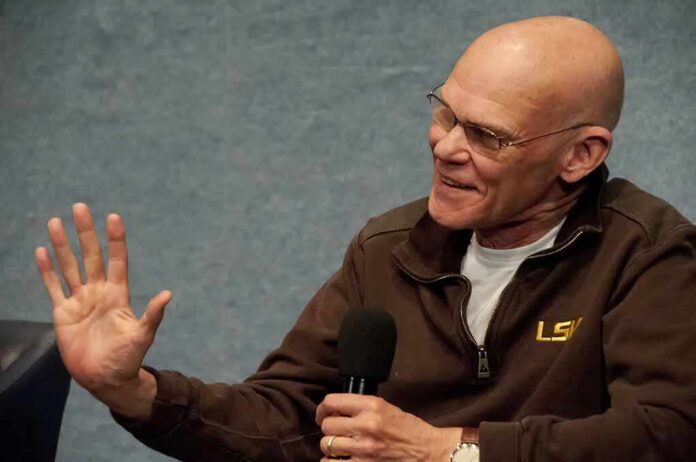
Democratic strategist James Carville sat on Fox News and called the Republican Party a “cult,” then turned around and trashed a fellow Democrat in crude terms for daring to endorse a Republican.
Story Snapshot
- James Carville told Fox News hosts the Republican Party is “a cult,” not a real political party.
- Carville made similar remarks on Jesse Watters Primetime and on Justice with Judge Jeanine.
- During the same appearances, Carville attacked Democrat Rep. Haley Stevens for endorsing a Republican candidate.
- Republican Party platforms stretching back to 1876 show a party built on stated principles, not personality worship.
- Political scientists say the “cult” label goes far beyond what the evidence actually shows.
Carville’s Cult Claim Hits Fox News Airwaves
James Carville went on Fox News and told viewers the Republican Party is not a party at all. “The Republican Party is not a party, it’s a cult. The Democratic Party is a coalition,” Carville said on Justice with Judge Jeanine. He repeated the line on Jesse Watters Primetime, arguing that coalitions have internal tension while cults do not. Watters pushed back with sarcasm, telling Carville, “Ok, we’re a cult, James.”
Carville’s framing sounds clever on television, but it falls apart under basic scrutiny. He claims cults never have internal disagreement, yet Republicans argue loudly over spending, immigration enforcement, and foreign policy inside their own party every week. Conservatives watching at home know the GOP is full of debate, not blind obedience. Carville’s talking point is a Democratic strategist’s spin, not a serious political analysis.
A Coalition Built on Insults?
While accusing Republicans of cult-like loyalty, Carville spent the same news cycle attacking his own party’s member. Rep. Haley Stevens, a Michigan Democrat, endorsed Republican Mike Rogers over Democrat Abdul El-Sayed, and Carville responded with a vulgar personal insult rather than policy disagreement. If the Democratic Party is truly the open “coalition” Carville describes, his reaction to a colleague’s independent endorsement looked less like healthy debate and more like enforced loyalty.
Carville has made a habit of lashing out at people inside his own party. He has called progressive Democrats “vicious” and accused them of using an “AI stupid idea generator” for their policy ideas. He even admitted he would rather see Republicans control the House by five seats than Democrats win by five, fearing his own party would become “hostage” to its socialist wing. That is not the behavior of someone speaking from a unified, principle-driven coalition.
The GOP’s Actual Track Record Tells a Different Story
Republican Party platforms dating back to 1876 lay out specific policy positions on the Constitution, national security, and economic growth, not loyalty to one man. The Republican National Committee describes the party’s founding principles as freedom, opportunity, and constitutionally guaranteed liberties, tracing back to its 1854 founding around ending slavery. The 2008 platform pledged to “constrain the federal government to its legitimate constitutional functions” and limit government reach into people’s lives. These are policy commitments, not cult doctrine.
Every modern Republican platform, from 1948 through 2008, spells out detailed positions on taxes, defense, and individual rights that voters can agree or disagree with on the merits. A real cult does not publish eighty years of written policy platforms for public debate. Carville’s “cult” label ignores a century and a half of documented party principles that have nothing to do with worshipping any single leader.
Political Scientists Say Label Doesn’t Fit
Academic researchers studying party loyalty use a much narrower term than “cult.” Scholars describe “personalist” parties, where elite careers depend more on loyalty to a leader than on independent policy positions, but they stop well short of calling this a literal cult. One study found some Republicans want President Trump to keep influencing the party, but that finding measures political loyalty, not the social control and isolation that define actual cults.
Even a Politico analysis noted that Trump functions more like “a movement figure” than a traditional party boss controlling every decision, a key distinction Carville’s rhetoric ignores entirely. Calling the opposing party a cult makes for a punchy soundbite on cable news, but it does not hold up against the party’s own written history or the research political scientists have actually produced on the subject.
James Carville slammed for vulgar ‘used condom’ remarks on Rep. Haley Stevens endorsing GOP candidate over Dem Abdul El-Sayed #HaleyStevens #JamesCarville #AbdulEl-Sayed #Midtermelectionhttps://t.co/Vo6E7jK4AN
— Chad Ousdahl (@OusdahlChad) November 3, 2026
Conservative voters frustrated by years of media double standards will recognize this pattern immediately. A Democratic strategist gets a friendly Fox News platform to call Republicans cult members, while his own insults toward a fellow Democrat get far less scrutiny. The facts, from century-old platforms to current academic research, tell a more grounded story than Carville’s talking point.
Sources:
mediaite.com, foxnews.com, presidency.ucsb.edu, nps.gov, edition.cnn.com