
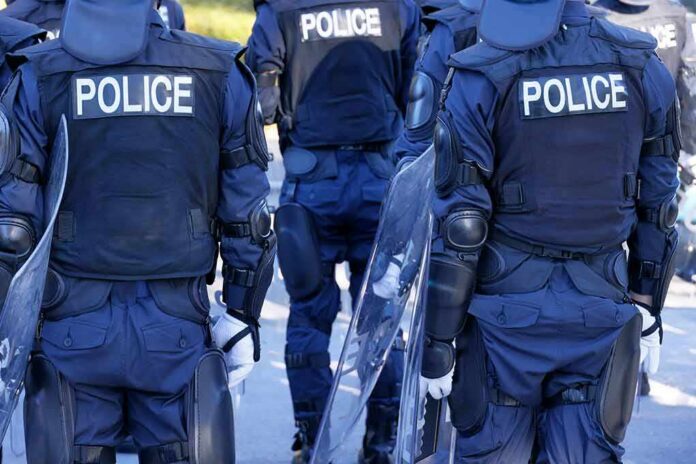
French police fired tear gas and blasted water cannons at demonstrators as hundreds of thousands flooded streets nationwide, protesting a cost-of-living crisis their own government’s taxes and spending helped create.
Quick Take
- Police used tear gas and water cannons against demonstrators in Paris and other French cities during nationwide protests.
- Protesters point to soaring fuel, energy and food prices, plus teacher shortages and crumbling schools, as the reason for the unrest.
- Hundreds of thousands reportedly marched nationwide, though French authorities counted just 32,800 people outside Paris by midday.
- The movement started with angry high school students before growing into a broad revolt over inequality and government spending.
- French officials blamed “ultra-left” agitators, while President Trump pointed to mass immigration, showing two very different explanations for the chaos.
Protests Erupt Nationwide Over Rising Costs
Demonstrations swept across France on October 17, 2026, as students, trade unions, workers and Yellow Vests took to the streets over rising living costs and crumbling public services. Reuters reported the protests spanned the country, pulling in groups that normally don’t march together. The common thread was simple: French families are getting squeezed by prices they can’t control, and the government isn’t fixing it.
A 19-year-old Paris protester named Lola summed up the anger well. “We are fighting because the cost of living is too harsh, because the price of fuel is too high, because high school pupils are being violently attacked and hurt all over the country just for trying to protest and ask for more teachers and decent learning conditions,” she told Reuters. That’s not radical rhetoric. That’s a young person asking for basic government function.
Schools Become Flashpoint Before Movement Spreads
The unrest didn’t start as a national uprising. It began at high schools in Paris’s northern suburbs, where students protested teacher shortages and run-down buildings, according to Reuters. From there, the anger spread into a much bigger fight over inequality, public spending, and the overall cost of living. Sound familiar? Government mismanagement of basic services tends to spark bigger fires than bureaucrats expect.
The frustration lines up with real economic pain. The Associated Press reported that recent spikes in gasoline, energy, and food prices fed directly into the public’s anger before the protests erupted. When a government lets energy costs spiral while expanding spending elsewhere, citizens notice. French families are living that lesson right now, and it should serve as a warning to any country tempted by the same path.
Police Deploy Tear Gas as Crowds Swell
The Associated Press confirmed that police used tear gas and water cannons in Paris against demonstrators during the nationwide protests. The response showed how far things escalated. French authorities said 140 separate protests took place outside Paris by midday, with 32,800 people counted in those demonstrations, even as the Associated Press described hundreds of thousands marching nationwide overall.
By a later wave of demonstrations, police reported even larger crowds, with 110,000 marching in Paris alone before tear gas and water cannons were again used to break up the protest. French authorities deployed up to 70,000 officers nationwide, backed by helicopters and armored vehicles, according to reporting on the government’s security response. That’s a massive show of force against citizens simply asking their government to control prices and fund schools properly.
Officials Trade Blame Over Cause of Unrest
French authorities placed blame for the disorder on the “ultra-left,” according to Reuters, a framing that shifts attention away from living costs and toward political extremism. Reports also noted that the unrest, including burned cars, looting and clashes with police, left it unclear how much of the chaos came from genuine protesters versus separate bad actors exploiting the moment.
🇫🇷📢🇫🇷 Over 400,000 people have taken to the streets in protests across France, according to BFMTV.
Trade unions, students, and "yellow vests" have joined the demonstrations. They are protesting against the rising cost of living and the deteriorating situation in education. pic.twitter.com/C9RcwEi5qa
— Hawkeye1812Z (@Hawkeye1745) October 24, 2026
President Trump weighed in with a different take, attributing the unrest to mass immigration and migrants, even though French authorities had not linked immigrants to the riots, according to reporting on the comments. Meanwhile, Reuters reported the turmoil was giving a political boost to far-right parties ahead of upcoming elections, as fuel-price anger translates into real electoral momentum. Whatever the cause, the pattern is clear: when governments let energy and living costs spiral out of control, voters eventually look for new leadership.
🇫🇷 The Ministry of the Interior estimates at least 410,000 people rallied across France for Saturday’s protests against the high cost of living, including 110,000 in Paris.
Meanwhile, reported nearly 800,000 demonstrators and 250,000 in the capital.
The situation in Paris… pic.twitter.com/Yv8YtVP8Sc
— FRANCE 24 English (@France24_en) October 24, 2026
Sources:
facebook.com, reuters.com, abc45.com, internazionale.it, cbc.ca