

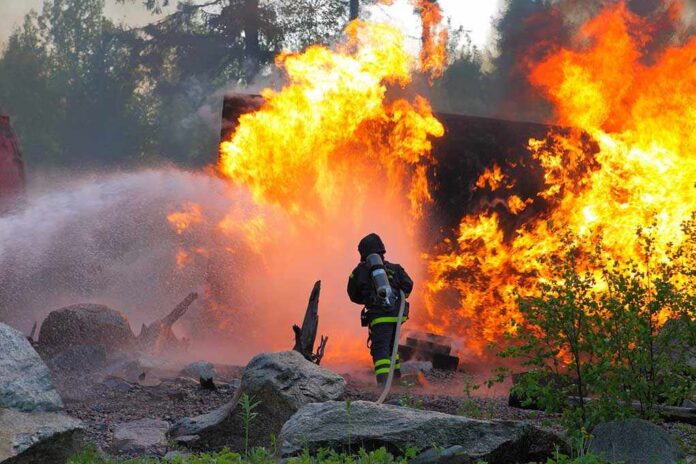
A fast-moving wildfire in northern Spain pushed toward a historic monastery complex, forcing evacuations and shutting a key highway, as emergency crews fought to hold the line.
Story Highlights
- Officials activated a regional emergency plan and deployed aircraft, brigades, and a mobile command to the fire zone.
- Authorities closed the A-132 highway and evacuated residents to nearby towns for safety.
- Regional leaders reported the fire slowed and half the perimeter was contained midweek.
- Crews protected heritage sites and removed select artifacts as a precaution.
Emergency Activation and Rapid Multi-Agency Response
Regional emergency services in Aragón declared the wildfire near Las Peñas de Riglos at midday on August 10 and raised the operational status to a high alert level. Commanders deployed a helicopter-borne brigade, two water helicopters, a coordination helicopter, four ground brigades, water tenders, an advanced command post, and support staff. Spain’s Emergency Military Unit joined the effort under the activated plan, underscoring the seriousness of the incident and the push for fast containment.
Officials described a layered response that grew as conditions changed. Reports on August 11 said the fire remained active and the perimeter was not yet secure, prompting crews to focus on keeping flames from crossing the A-132 roadway. Agencies from Aragón and neighboring areas coordinated air drops and ground work to build and hold control lines while tracking shifting winds and terrain that challenged suppression plans.
Highway Closure and Evacuations to Protect Lives
Authorities cut the A-132 highway and ordered preventive evacuations as smoke and fire made travel unsafe. Early counts said 120 people were moved to shelters in Ayerbe and Jaca, with more than 200 responders engaged from the regional government, the Emergency Military Unit, the national ecological ministry, and neighboring Navarra. These measures aimed to clear at-risk areas and keep routes open for engines, aircraft support, and ambulance access during the peak burn period.
As the week continued, evacuation totals reported by various outlets rose into the hundreds while crews worked through the night to slow spread. By Saturday, firefighters and the Emergency Military Unit were still on the lines, working overnight to cool hot spots and tighten control. That persistence reflected the rugged terrain and dry fuels in Huesca province, where containment often depends on long shifts and steady pressure across several flanks rather than a single decisive push.
Threat to San Juan de la Peña and Cultural Safeguards
Authorities placed special focus on protecting the San Juan de la Peña monastery complex, a key cultural site in Aragón. Reports said the fire approached the area without reaching the historic structures. To reduce risk, officials evacuated some of the most valuable artifacts from the site as a precaution. This step matched common practice in heritage protection during wildfires, where early removal of select items buys time if conditions worsen near irreplaceable buildings.
PE is not that relevant.
There is something more systemic in engineering, design and sales logistics.
Legacy auto is an ugly, ugly Frankenstein combination of massive, insurmountable problems. They must implode under their own bureaucratic weight, except for government edict.…
— Ian Szkolak (@ianszkolak) August 10, 2026
Regional leaders offered cautious updates as lines held. On August 12, the Aragón minister said the fire was advancing very slowly and that half of the perimeter was contained, with crews working to stop spread on the right flank. That status signaled progress without ending risk, since wind changes and embers can test control lines. Still, the report showed that air and ground teams had begun to turn the corner after the first intense days.
Why This Matters to American Readers
Heritage under threat anywhere should grab our attention. A blaze near a centuries-old monastery reminds us that culture and faith landmarks are fragile in the face of disaster. American readers know this risk at home, from churches in fire country to battlefields and museums in the path of smoke and flame. The Spanish response shows how clear command, rapid air support, and careful evacuation of people and artifacts can protect life and legacy when minutes count.
What to Watch Next
Authorities will work to firm up containment, reopen the A-132, and verify damage. Incident logs, perimeter maps, and shelter records will clarify exact timelines for closures and evacuations. For now, reports confirm fast activation, multi-agency teamwork, and targeted protection of a treasured monastery site. Continued overnight work and aircraft support point to a sustained push to secure lines and let residents return safely when conditions allow.
Sources:
elconstitucional.es, heraldo.es, bernama.com, europapress.es, ground.news